You’ve booked a week in Brittany. Carnac is on the list. Vannes too. Then someone mentions Sainte-Anne-d’Auray, and you search it. The results are mostly religious pilgrimage content. You’re not sure if it’s worth an afternoon detour if faith isn’t your thing.
It is. But only if you go prepared.
Sainte-Anne-d’Auray is the most important Marian pilgrimage site in Brittany — France’s second most visited Catholic pilgrimage destination after Lourdes. But it also holds a compelling war memorial, a genuinely surprising museum, and an atmosphere that’s hard to find anywhere else in Morbihan. The trick is knowing what to prioritize and when to show up.
What Sainte-Anne-d’Auray Actually Is
In 1624, a peasant farmer named Yves Nicolazic reportedly had a series of visions of Saint Anne — the mother of the Virgin Mary — near the village of Ker Anna. She told him to build a chapel. He did. That chapel became the foundation of a pilgrimage that now draws up to 800,000 visitors per year.
That’s the legend. Here’s the context that makes it interesting even if you’re skeptical of miracles.
Sainte-Anne-d’Auray became deeply tied to Breton identity at a time when Brittany was actively asserting its cultural distinctiveness from France. Saint Anne is the patron saint of Brittany, not just a generic Catholic icon. Pilgrimage here was an act of cultural identity as much as devotion. That tension still shows up in the architecture, the processions, and the bilingual signage throughout the complex.
Then there’s the WWI connection. After the First World War, Brittany had lost a higher proportion of its young men than almost any other French region. The Monument aux Morts de Bretagne was built here in 1932 as a result. It lists over 240,000 Breton soldiers killed in the war. Standing in front of it is genuinely affecting, regardless of your religion or nationality.
The town itself — about 2,500 permanent residents — exists almost entirely because of the sanctuary. Hotels, restaurants, pilgrim hostels, religious souvenir shops. Compact and walkable. You don’t need more than half a day here unless you’re attending a major event.
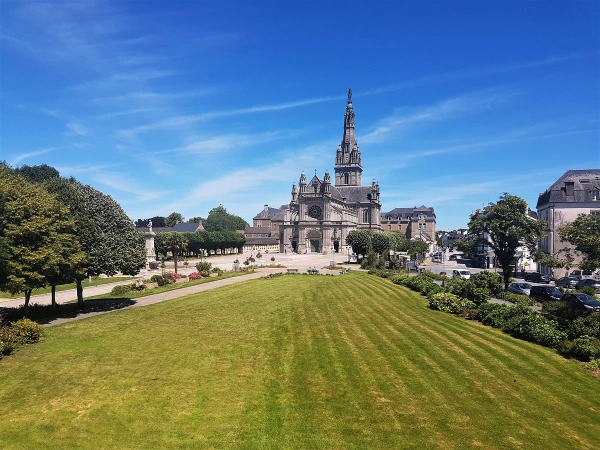
One thing most visitors miss: the current sanctuary complex is relatively young. The large neo-Gothic basilica was built between 1866 and 1872. The older, more historically loaded structure is the 17th-century cloister that predates it. The site has been continuously modified and expanded over four centuries — the layers of history are there if you look for them, they’re just not obvious from the main esplanade.
The Sanctuary’s Main Sites: What’s Worth Your Time
The complex is bigger than it looks on a map. Here’s what’s inside and an honest assessment of each.
| Site | What It Is | Time Needed | Worth It? |
|---|---|---|---|
| Basilica of Sainte-Anne | Neo-Gothic basilica built 1866–1872, houses the venerated statue of Saint Anne | 20–30 min | Yes — scale impresses even if the style doesn’t |
| Scala Sancta | Holy stairs replicated from Rome, ascended on knees by pilgrims | 10 min (to observe) | Yes — ritual you won’t see elsewhere in Brittany |
| Trésor de la Basilique | Museum: ex-votos, religious art, historical objects from 1600s to present | 30–45 min | Absolutely — best thing in the complex (€3 entry) |
| Monument aux Morts de Bretagne | WWI memorial listing 240,000+ Breton soldiers killed in the war | 15–20 min | Yes — don’t rush this one |
| The Cloister | 17th-century cloister with quiet garden, predates the current basilica | 15 min | Yes — most peaceful spot on the whole site |
| Fountain of Saint Anne | Sacred spring near the original chapel site | 5 min | Quick stop only — skip if you’ve seen Breton sacred fountains before |
Why the Trésor Is Worth €3
The Trésor de la Basilique is the hidden gem of the complex. Inside: hundreds of ex-votos — small painted plaques left by pilgrims who believed Saint Anne answered their prayers. They cover shipwrecks, illness, war survival, childhood accidents. Some date to the 1600s. The art ranges from crude and immediate to surprisingly accomplished.
This isn’t a polished museum with interpretive panels. It’s a raw accumulation of four centuries of human crisis and gratitude. Nothing else in the sanctuary comes close for historical weight. Everyone who skips it because of the €3 entry fee regrets it once they find out what’s inside.
The Basilica: What to Actually Notice
The basilica is 73 meters long, built in neo-Gothic style. Large and competently designed, but anyone who’s spent time in Chartres or Reims will find the architecture unexceptional. Worth noting: the central statue of Saint Anne with the young Virgin Mary is the one brought out in full procession during the Grand Pardon. The stained glass on the north side has better colour than the south. Morning light is better for the interior than afternoon.
The August 26 Grand Pardon: Go or Stay Away?
Go if you want to see Brittany at its most communal. Stay away if you have mobility issues or can’t tolerate dense crowds.
The Grand Pardon of Sainte-Anne falls every year on August 26. It’s the largest pilgrimage gathering in Brittany — 20,000 to 30,000 people in a single day. Bishops from across the region attend. Traditional Breton costumes appear in force. Processions start at dawn. The atmosphere is genuine: this is not a performance staged for tourists, it’s a functioning religious and cultural event that happens to be open to observers.
Parking fills before 7am. Book accommodation in Auray, 5km away, at least two months out. Arrive before 8am or after 3pm to have any realistic chance of navigating the site without being shoulder-to-shoulder the entire time. Bring water — shade is limited across the main esplanade.
A One-Day Itinerary That Actually Works
Budget 2.5 hours for the sanctuary itself. Stretching to a full day means killing time in souvenir shops. Pair it with Auray’s old town or Carnac on the same day.
- 9:00am — Arrive at the sanctuary. Parking is free on the main esplanade. Go directly to the Trésor before it fills up. Opens 9am; closes 12–2pm for lunch on most days — verify in advance.
- 9:45am — Walk the cloister. Quiet at this hour, genuinely peaceful.
- 10:15am — Enter the basilica. Morning light works better for the interior.
- 10:45am — Scala Sancta and fountain. Combined: about 15 minutes.
- 11:00am — Monument aux Morts de Bretagne. Spend real time here. Read the panels.
- 11:30am — Coffee at one of the cafés on Rue de Vannes. Functional, not destination-worthy.
- 12:30pm — Drive to Auray’s Quartier Saint-Goustan (12 minutes). Lunch by the medieval harbour at one of the riverside restaurants.
If you’re substituting Carnac instead of Auray: drive southwest from the sanctuary, about 20 minutes. The Alignements de Kermario are the best starting point — less crowded than the main Ménec alignments, and the standing stones are just as impressive. Go before 11am before the tour groups arrive.
Getting There: Train, Car, and What Not to Attempt
Sainte-Anne-d’Auray has no train station. The nearest is Auray station, 5km away, on the Paris-Quimper TGV line. From Auray station to the sanctuary: taxi runs €10–12 (no Uber in this area); a shuttle bus operates during peak pilgrimage season but not year-round; cycling takes 25 minutes on a secondary road that’s manageable but not purpose-built for bikes.
From Vannes
20km east. By car: 25 minutes on the N165. By train: TER to Auray takes 8 minutes, then taxi to the sanctuary. The connection works, but adds friction — budget 40 minutes total from Vannes city centre to the sanctuary esplanade.
From Rennes
TGV from Rennes to Auray: approximately 1 hour 20 minutes, €25–45 depending on booking lead time. Add a taxi at Auray and this is a workable day trip from Rennes if you leave by 8am. The sanctuary, the war memorial, and lunch in Auray’s Quartier Saint-Goustan make a full and satisfying day without a car.
From Carnac
No direct transit connection. By car: 20 minutes northwest. If you don’t have a car, this combination isn’t practical. The Morbihan region simply works better with wheels — the distances between sites are too short to justify trains but too spread out to walk.
Six Mistakes That Will Waste Your Visit
- Visiting on Sunday morning without checking mass times. The basilica fills completely during Sunday mass. You can’t walk through or examine anything properly. Go on a weekday, or arrive before 9am on a Sunday.
- Skipping the Trésor because the €3 entry feels unnecessary. The ex-voto collection is the most historically significant thing in the complex. This is the one mistake with no recovery — you either see it or you don’t.
- Treating it as a 45-minute stop. The Monument aux Morts de Bretagne alone deserves 20 minutes if you read the panels. Rushing through means missing the cumulative weight that makes the place stick with you.
- Arriving hungry and expecting good food on-site. The cafés around the sanctuary are functional. Eat before you come, or plan to eat in Auray afterward at Quartier Saint-Goustan, which has proper restaurants on the harbour.
- Going in November through February without checking opening hours. The Trésor has limited winter hours, and some guesthouses close entirely off-season. The sanctuary grounds are always accessible, but the museum — the best part — may be shut.
- Driving into the centre on August 26 without a parking strategy. The main esplanade fills before 7am on the Grand Pardon. Park in Auray and take a taxi or the event shuttle. Don’t attempt to drive in late.
Pairing Sainte-Anne-d’Auray with the Rest of Morbihan
On its own, Sainte-Anne-d’Auray is half a day. Paired correctly, it anchors one of the better two-day circuits in coastal France.
Day 1: Sainte-Anne-d’Auray in the morning (9–11:30am), then Auray’s Quartier Saint-Goustan for lunch at the medieval harbour. Afternoon: boat trip on the Golfe du Morbihan from Vannes harbour. Navix runs one-hour gulf circuits for around €20 per adult — you see Île-aux-Moines, the salt marshes, and a scatter of small islands without committing to a full island day trip.
Day 2: Carnac’s megalith alignments before 10am. The Alignements de Carnac span Ménec, Kermario, and Kerzerho — more than 3,000 standing stones across nearly 4km of fields. Bring proper shoes. Afternoon in Vannes: the medieval ramparts, Vannes Cathedral (dating to the 13th century, far older than the Sainte-Anne basilica), the covered market at Place des Lices, dinner near the port.
This two-day structure covers prehistoric Brittany (Carnac), sacred Brittany (Sainte-Anne-d’Auray), maritime Brittany (the Gulf), and medieval Brittany (Vannes). Those four things are what Morbihan does better than anywhere else in France.
The region is compact enough that nothing is more than 30 minutes from anything else by car. That’s the whole argument for renting one for this stretch of Brittany — and once you’ve done this circuit, you’ll understand why people keep returning to this part of the coast.