You booked a week in Alsace, pulled up a map of the Route du Vin, and immediately felt overwhelmed. 170 kilometers of winding roads. 67 wine villages. Dozens of Grand Cru vineyards. Every blog tells you to visit “charming medieval towns” but nobody tells you which ones are worth your Saturday afternoon and which are a parking nightmare with overpriced Riesling.
I spent two weeks driving the Route du Vin in 2026, tasting at 22 domaines, and getting stuck in Riquewihr during August rush hour so you don’t have to. Here’s the itinerary that works — the one that balances great wine, real villages, and your sanity.
Why Most Route du Vin Itineraries Fail
Most guides treat the Route du Vin like a checklist. Visit 12 villages in 3 days. Taste at 8 domaines. Take photos of half-timbered houses. This approach fails for three concrete reasons.
Reason one: tasting fatigue. After your fourth Gewürztraminer at 11 AM, every wine starts tasting the same. Your palate shuts down around tasting number six. By day two, you’re buying bottles just to feel something.
Reason two: parking. Riquewihr and Eguisheim have parking lots designed for 50 cars that receive 500 cars daily in summer. You will spend 30 minutes circling. You will park 800 meters from the village center. You will be annoyed.
Reason three: the Grand Cru trap. Many tourists fixate on the 51 Grand Cru vineyards. They drive from one to another, take a photo of the sign, and miss the real story — the family domaines that don’t appear on any official map but produce better wine at half the price.
Here’s what actually matters: you need rest days. You need a maximum of two tasting stops per day. You need to skip the most crowded villages at peak hours. And you need to know which domaines accept walk-ins versus requiring appointments.
The Real Problem Nobody Talks About
The Route du Vin is not a single road. It’s a network of D-roads that snake through the foothills of the Vosges mountains. The official route is marked by brown signs with grape clusters, but Google Maps doesn’t recognize it as a single route. You will miss turns. Plan for it.
Cell service drops in the valleys between villages. Download offline maps before you leave Colmar or Strasbourg. I lost signal twice between Ribeauvillé and Bergheim and ended up on a farm road that dead-ended at a cow pasture. Charming in retrospect. Frustrating at 4 PM with a tasting appointment.
The Only 6-Day Route du Vin Itinerary You Need
This itinerary starts in Strasbourg, ends in Colmar, and covers the best 40 kilometers of the Route du Vin. It skips the southern section (Thann to Guebwiller) unless you have extra days — that area is quieter but has fewer standout domaines.
| Day | Base Village | Morning | Afternoon | Evening |
|---|---|---|---|---|
| 1 | Strasbourg | Arrive, explore Petite France | Cathedral, La Cloche à Fromage for cheese | Dinner at Maison Kammerzell |
| 2 | Strasbourg → Molsheim | Pick up rental car, drive to Molsheim (30 min) | Tasting at Domaine Marcel Deiss (by appointment) | Sleep in Obernai |
| 3 | Obernai → Barr → Mittelbergheim | Walk Obernai market (Wed/Sat) | Tasting at Domaine Ostertag (walk-in OK) | Dinner at Au Gout du Jour, Mittelbergheim |
| 4 | Ribeauvillé | Visit Hunawihr (quiet, no crowds) | Tasting at Domaine Trimbach (appointment only) | Sunset at Château du Haut-Kœnigsbourg |
| 5 | Riquewihr | Arrive at 9 AM before crowds (parking lot P1) | Tasting at Domaine Hugel (walk-in welcome) | Sleep in Kaysersberg (quieter, better value) |
| 6 | Colmar | Little Venice, Unterlinden Museum | Tasting at Domaine Zind-Humbrecht (appointment) | Return car, depart |
Why This Route Works
It clusters villages by proximity. Day 2 stays north. Day 3 stays central. Day 4-5 stays around Ribeauvillé. You never drive more than 40 minutes between stops. You visit the tourist-heavy villages (Riquewihr, Eguisheim) early in the morning or late afternoon — 9 AM or 5 PM, never between 11 and 3.
The itinerary also builds in one “skip” day. Day 4 can be swapped: if you’re tired of wine, visit the Château du Haut-Kœnigsbourg instead. If you want more wine, add a tasting at Domaine Weinbach in Kaysersberg. Flexibility matters more than checking boxes.
Which Villages to Skip (and Which to Prioritize)
Every Route du Vin article lists the same villages. Here’s the truth about each one.
Skip Eguisheim at noon. It’s beautiful. It’s also a human traffic jam between May and October. The parking lot fills by 10:30 AM. If you go, arrive at 8:30 AM, walk the circular village in 45 minutes, and leave before the tour buses arrive. The wine shops here charge 20% more than the same bottles in Barr.
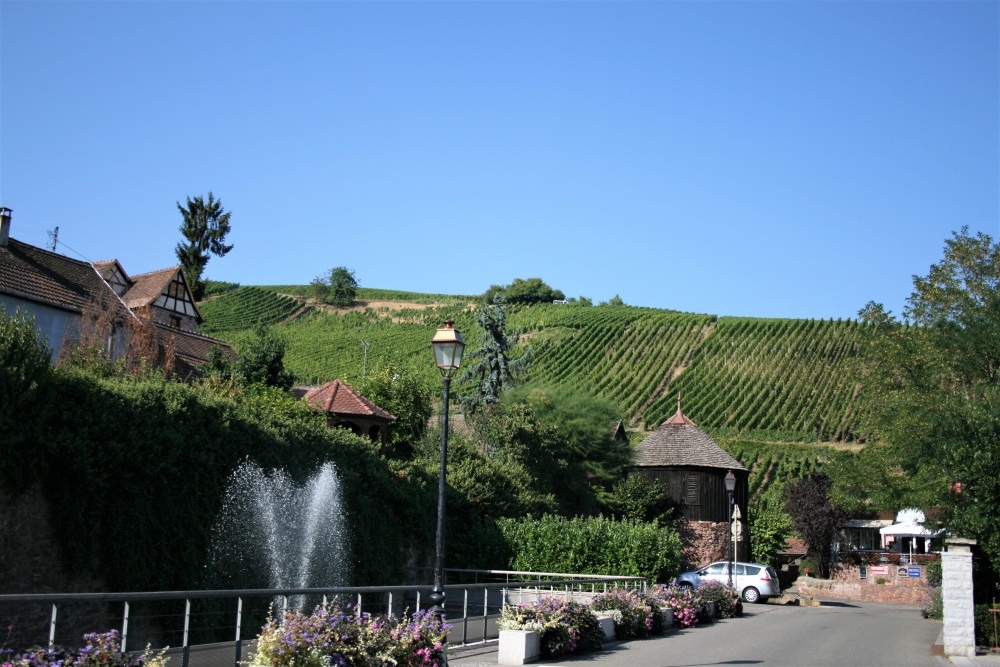
Prioritize Mittelbergheim. This is the quietest classified village on the route. It has one bakery, one restaurant (Au Gout du Jour, book ahead), and three domaines that welcome walk-ins. The Zotzenberg Grand Cru vineyard sits right above the village. You can walk to it in 10 minutes. No crowds, no souvenir shops, just wine and silence.
Riquewihr is worth the chaos — once. It’s the most photographed village in Alsace for a reason. The Dolder gate, the cobblestones, the pastel facades — it’s authentic. Go on a weekday. Park in lot P1 (€5, closest to the old town). Visit Domaine Hugel for a tasting (they speak English, walk-ins accepted, €12 for 5 wines). Buy a bottle of their Gewürztraminer Sélection de Grains Nobles if you want to spend €45 on something unforgettable.
Kaysersberg is better than Riquewihr for sleeping. Hotels cost 30% less. The village has a real river running through it, a ruined castle you can hike to in 20 minutes, and fewer selfie sticks. Domaine Weinbach here produces some of Alsace’s best Riesling (their Schlossberg Grand Cru, around €35, is a benchmark).
The One Village Everyone Forgets
Bergheim. It’s 3 kilometers north of Ribeauvillé, has a 14th-century wall, and almost zero tourism. The tasting room at Domaine Marcel Deiss is here (by appointment only, €15 for a guided tasting of 8 wines). Their Altenberg de Bergheim Grand Cru is a field blend — multiple grape varieties planted together, harvested together, fermented together. It tastes like liquid geology. You won’t find this wine outside Alsace.
How to Taste Wine on the Route du Vin (Without Getting Ripped Off)
Tasting etiquette on the Route du Vin is different from Napa or Tuscany. Most domaines charge for tastings — expect €5-15 for 4-8 wines. This fee is usually waived if you buy a bottle. Do not expect free tastings. Do not expect to taste 15 wines for free. That’s not how Alsace works.
Call ahead for Grand Cru domaines. Domaine Trimbach, Domaine Zind-Humbrecht, and Domaine Weinbach require appointments. You can book by phone or email 2-3 days in advance. Walk-ins are accepted at smaller domaines like Domaine Ostertag (Barr) and Domaine Bott-Geyl (Beblenheim).
Bring cash. Many small domaines don’t accept cards. The ATM in Ribeauvillé runs out of cash on weekends. Withdraw €100 in Colmar or Strasbourg before you start.
Spit or swallow — your choice, but pace yourself. A standard tasting pour is 3-4 centiliters. Six tastings equals roughly one full glass of wine. If you’re visiting 2 domaines in a day, you’re drinking 2-3 glasses total. That’s fine. But don’t visit 4 domaines and drive. The gendarmes do random breathalyzer checks on the D-road between Ribeauvillé and Riquewihr. The limit is 0.5 g/L (about one glass).
What to Buy (and What to Skip)
Buy Riesling from the Grand Cru vineyards: Schlossberg, Brand, and Schoenenbourg. These age for 10-20 years. A 2026 Domaine Weinbach Schlossberg Riesling costs around €35 and tastes like lime zest and wet stone. It will be better in 2030.
Buy Crémant d’Alsace from any small domaine. It’s Alsace’s sparkling wine, made the same way as Champagne, for €8-15. Domaine Jean Huttard in Obernai makes a Crémant Rosé (€11) that beats many €30 Champagnes.
Skip the Edelzwicker in souvenir shops. Edelzwicker is a generic blend, usually the lowest quality wine from a domaine. If you see a bottle for €4, it’s table wine. Not worth the luggage space.
Skip late-harvest wines unless you love sweet wine. Vendange Tardive and Sélection de Grains Nobles are expensive (€30-80) and very sweet. They’re excellent with foie gras or blue cheese. They’re not everyday drinking wines.
The Biggest Mistake Travelers Make on the Route du Vin
They try to do too much. I met a couple from Chicago who planned to visit 8 villages in 2 days. By day two, they were arguing in a parking lot in Eguisheim. They had bought 14 bottles they didn’t need. They had not eaten lunch because every village had a 45-minute wait for restaurants. They were tired, hungry, and over-wined.
The fix: pick two villages per day, maximum. One in the morning (10 AM – 12:30 PM), one in the afternoon (2 PM – 5 PM). Eat a proper lunch at a table, not a baguette on a bench. Drink water between tastings. Buy only bottles you would open at home within the next month — unless it’s a Grand Cru Riesling, which you can cellar.
Another mistake: not booking dinner. Restaurants in villages like Mittelbergheim and Kaysersberg seat 30-40 people. In summer, they’re fully booked by 10 AM. Reserve online or ask your hotel to call. Au Gout du Jour in Mittelbergheim (€45 for a 3-course menu with wine pairing) requires 48 hours notice. Winstub Gilg in Ribeauvillé (€38 for choucroute royale) accepts same-day calls but fills by 6 PM.
One more: ignoring the off-seasons. The Route du Vin is best in May and September. May has wildflowers and fewer crowds. September has harvest activity and golden light. July and August are crowded and hot — many tasting rooms don’t have air conditioning. November through March is quiet, but many domaines close for winter holidays and annual leave. Check opening hours before you go.
The Alsace wine road rewards slow travelers. The best memory from my two weeks wasn’t a Grand Cru tasting or a famous village. It was sitting on a bench in Mittelbergheim at 6 PM, drinking a €7 glass of Domaine Ostertag Riesling, watching the sun hit the Zotzenberg vineyard. No agenda. No rush. Just a good glass of wine in a place that knows how to make it.