The Misconception That Ruins the Experience
Most visitors arrive at My Son expecting Vietnam’s version of Angkor Wat. They leave disappointed — not because My Son failed them, but because that benchmark was always the wrong one.
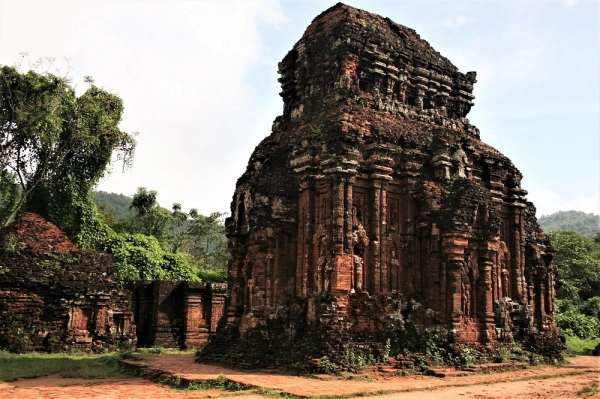
My Son is not a sprawling temple city. It’s a compact valley complex of Hindu brick towers built by the Cham civilization between the 4th and 14th centuries. At its peak, over 70 structures stood here. Then came August 1969 — a single round of B-52 bombing raids during the Vietnam War destroyed most of what 1,400 years of weathering had left intact. What you walk through today is the survivor: roughly 20 significant structures, ranging from beautifully preserved to scattered rubble on open ground.
That history is the whole point.
My Son became a UNESCO World Heritage Site in 1999, not for its scale, but for what it represents: one of the most complete surviving records of the Cham civilization, a Hindu kingdom that controlled central Vietnam for over a millennium. Every lingam-shaped tower and carved sandstone frieze encodes religious symbolism from a culture most Western visitors know almost nothing about before arriving.
The marketing problem is real. Travel agencies bundle My Son into a quick day trip alongside Hoi An Ancient Town and the Marble Mountains, which frames it as a 90-minute checkbox activity. You can visit in 90 minutes. You probably shouldn’t. Visitors who rush through without reading a plaque consistently leave underwhelmed. Those who spend three hours, hire a local guide, and catch the morning Cham dance performance leave with something actually worth remembering.
Bottom Line: Adjust the benchmark. My Son is closer to visiting a specific Roman temple than walking through Rome. That framing makes it exactly what it is — compact, dense with meaning, and worth the trip if you arrive prepared.
The Cham Civilization in 90 Seconds
The Champa Kingdom controlled central and southern Vietnam for roughly 1,000 years. They were maritime traders shaped heavily by Indian culture and Hinduism. My Son was their spiritual center — not a city, but a sacred sanctuary where Cham kings came to be consecrated before Shiva. These are not monuments to rulers. They are temples built to honor the divine protector of a kingdom. That framing changes how you read every carving you encounter on site.
What the 1969 Bombing Actually Destroyed
Early French colonial survey photographs from the 1900s show what Group B at My Son looked like before the war — intricate, multi-tiered towers with carved galleries around a central sanctuary. Most of that is gone. The finest surviving Cham carvings are no longer at My Son. They’re 70km away at the Da Nang Museum of Cham Sculpture, which holds the largest collection of Cham artifacts in the world, including stonework removed from My Son before the bombings. Entry costs 60,000 VND (about $2.50 USD) and takes roughly 90 minutes. Visiting the museum before My Son makes the ruins significantly more legible — though if you can only do one, choose the ruins.
4 Ways to Get There from Hoi An: Real Costs Compared
My Son sits 40km southwest of Hoi An — 50 to 60 minutes by road on a well-maintained route. All four transport options work. The difference is cost, schedule control, and how much the journey itself matters to you.
| Transport Option | Approximate Cost | Journey Time | Best Suited For |
|---|---|---|---|
| Grab (car, one way) | 180,000–250,000 VND (~$7–10) | 50–60 min | Solo travelers or couples wanting flexible timing |
| Rented motorbike | 100,000–150,000 VND/day + fuel | 40–50 min | Confident riders who want maximum independence |
| Group day tour | $8–18 USD return, guide included | ~1 hour by bus | First-timers who want context built in |
| Thu Bon River boat | $20–35 USD full day, return | ~2.5 hours each way | Travelers for whom the journey is the point |
The Grab option delivers the best mix of cost and control. You pay roughly the same as a budget group tour but set your own schedule — which matters when arriving before 8:30am is the difference between a quiet morning among the towers and fighting through three tour buses in the parking lot. Download Grab before arriving in Vietnam; it works reliably across Hoi An and Da Nang, and fares are locked before you confirm the ride.
The Thu Bon River boat tour gets marketed as the romantic, authentic approach to My Son. In practice, the boat leg is two and a half hours each way on a wide, flat river with limited shade and minimal scenery variation. The experience at My Son itself is identical to arriving by road. Take it if the river journey specifically appeals — don’t take it expecting a better outcome at the ruins.
Group Tours: What the Price Gap Actually Buys
Tours priced under $10 USD typically allocate 90 minutes on site. Tours in the $15–18 range give you 2.5 to 3 hours plus a guide with real knowledge of Cham iconography. That gap matters here more than at most archaeological sites in Southeast Asia. My Son’s own signage is sparse. The carvings — apsara dancers, kala demon faces, lotus motifs — mean nothing without context. A guide who can explain what each motif represents in Hindu cosmology turns a walk past old bricks into actual history. The cheap tour is not the better deal at this particular site.
Practical tip: Entry to My Son costs 150,000 VND (about $6 USD) and is cash only at the gate. No ATM exists on site. Bring the exact amount in Vietnamese dong before leaving Hoi An.
The One Timing Rule Worth Knowing
Arrive before 8:30am or plan to arrive after 3:30pm. My Son sits in a valley with almost no shade. Between 10am and 2pm, air temperatures regularly hit 37°C to 39°C in peak season, with brick surfaces radiating additional heat at ground level. The majority of group tours arrive between 9:30am and 10:30am. Going earlier is not just more comfortable — it means you have the entire site to yourself for the first hour, which is a qualitatively different experience.
The morning Cham dance performance runs at approximately 9:30am near the entrance. Early arrival catches it fresh, before the buses.
What You’ll Actually See: A Practical Guide to the Temple Groups
My Son divides into lettered groups spread across the valley floor. Not all are equally worth your time. Here’s an honest breakdown:
- Groups B, C, and D — The core of the site. Group B is the main sanctuary complex and the architectural centerpiece, even in its damaged state. Groups C and D hold smaller towers and surviving entrance halls (mandapa) with the most detailed carvings on site. Spend at least 45 minutes in this area. Don’t rush through it to get to the next group.
- Group G — A well-preserved tower with a notable Shiva lingam, one of the cleaner examples of intact Cham tower construction remaining. Worth a 15-minute stop.
- Groups E and F — Smaller, quieter, fewer visitors. Some partial reconstruction is visible. Best visited early morning when the light is good for photography and the crowds haven’t arrived.
- Group A — Largely destroyed in 1969. Architecturally significant to specialists; less visually rewarding for general visitors. Worth walking past, not worth extended time.
- Group H — The furthest point from the entrance, a 20-minute walk across open ground. Worth the detour on a cool morning or late afternoon. Comfortably skippable in midday heat without missing anything essential.
The On-Site Museum: Don’t Walk Past It
The small museum near the entrance is air-conditioned — a practical reason to stop regardless of interest level. It holds original carvings removed from the towers for preservation, stone inscriptions in ancient Cham script, and English-language panels on Cham religious symbolism that the outdoor signage never covers. Twenty minutes here before walking the grounds changes how much you understand for the rest of the visit. It’s one of the most consistently skipped features on site, and that’s a mistake.
The Cham Dance Performance: Go
The performance runs 20 to 25 minutes and draws on traditional Cham court dance reconstructed from ancient stone carvings. The form was nearly lost and has been methodically revived by trained performers. It’s also held in a covered pavilion, which makes it a practical shaded rest mid-morning. Check the current schedule at the ticket window when you arrive — timing shifts slightly by season and day.
Practical tip: My Son enforces a dress code in the main sanctuary areas: shoulders and knees covered. Lightweight cotton trousers handle the heat reasonably well. Sarong rentals are available near the entrance for 10,000–20,000 VND if you forget.
When My Son Is Worth It — And When to Choose Something Else
My Son is the right call if you’re spending more than two days around Hoi An and have any genuine interest in history, archaeology, or cultures outside the standard tourist circuit. Total cost sits under $10 USD. A half-day investment gives you context for central Vietnam that makes subsequent sites — the Imperial City at Hue, the Marble Mountains near Da Nang — more meaningful, not less.
But it’s not right for everyone, and being honest about that is more useful than a blanket recommendation.
When to Skip My Son
If you’re on a tight two-day Hoi An stop and the real choice is between My Son and a hands-on cooking class or a morning on the water, take the other option. A rushed, underprepared visit in midday heat is not a trip highlight. My Son rewards patience and context. It punishes visitors who show up with 90 minutes and no background knowledge.
Also consider carefully if Angkor Wat is already on your Southeast Asia itinerary. The scale difference is enormous — the Angkor complex covers roughly 400 square kilometers; My Son is a single valley with 20 structures. Some travelers visit both and appreciate My Son for its intimacy and emotional weight. Others feel that the Angkor comparison makes My Son feel diminished, even though that’s an unfair frame. Be honest about which type you are before you spend a half-day and $10 finding out.
My Son vs. Da Nang Museum: Which Matters More?
If the schedule allows only one: My Son, because in-situ ruins carry a weight that museum displays can’t replicate. But the Da Nang Museum of Cham Sculpture shows you the finest surviving Cham art in existence, including carvings taken directly from My Son before the war. Doing the museum in the morning and My Son in the early afternoon of the same day is the strongest combination available in this region. Combined entry costs under $10 USD total. The logistics — 70km between sites — are the only real obstacle.
Disclaimer: All prices are based on 2026 research and visitor reports. Entry fees and exchange rates change. Verify current costs before travel. This is independent travel writing, not sponsored content.
The visitors who rate My Son among the best experiences of their Vietnam trip almost always did one thing the disappointed visitors didn’t: they read about the Cham civilization before they arrived.