Île aux Moines sits in the Gulf of Morbihan, 800 metres off the Breton coast near Baden. It is the largest island in the gulf — roughly 320 hectares — and the most visited. Those two facts are connected, and not in a way that benefits a poorly planned visit.
Most visitors treat the crossing as an afterthought. The ferry is short, the fares are low, the island looks manageable on a map. Then they arrive in August at 11am and spend four hours competing with hundreds of other visitors for the same narrow paths and the same small beaches. The island did not fail them. Their planning did.
Why Most Île aux Moines Visits Underdeliver
Here is the scenario that plays out thousands of times each summer. You drive from Vannes, park at Port-Blanc, board the Izenah Croisières ferry, and arrive on the island at 11am on a Saturday in late July. Every bike at the two rental points is already gone. Plage du Locmiquel, the island’s best-positioned beach, has no usable space. The café you bookmarked has a 40-minute wait. You walk a loop around the village, see some coastal scenery, and leave two hours later feeling the island was overhyped.
That outcome is predictable. And entirely avoidable.
Île aux Moines has roughly 600 permanent residents and no meaningful tourist infrastructure for private cars. The commune limits vehicle access, so the island’s roads stay quiet — but the footpaths and bike routes absorb everything the ferries deposit, and in peak season, the ferries run continuous shuttles. The island processes over 400,000 visitors annually through pathways and facilities sized for a Breton village. The math stops working fast.
The Overcrowding Calculation
July and August are the outlier months. On busy summer weekends, the Port-Blanc car park — roughly 250 spaces — fills before 9:30am. Ferry queues on the return leg run 30 minutes or more in the afternoon. Bike rental capacity across all island providers sits around 200–250 units total. Arrive after 10am and you are working with whatever is left.
The relationship between arrival time and visit quality is not a curve — it is a cliff. Arriving at 8am versus 11am does not produce a marginally better experience. It produces a fundamentally different one.
What Visitors Miss on the Megalithic Sites
Île aux Moines contains one of the denser concentrations of Neolithic monuments in Morbihan, which is already a region saturated with prehistoric remains. The Dolmen de Pen Hap, the menhirs near the Tour du Château, and the stone alignments on the island’s northern end represent a genuine reason to cross the gulf — one that most day visitors never access.
The problem is signage. The inland sites are not aggressively marked on the tourist-facing path network. Cyclists following the perimeter route miss them entirely. Walkers without a downloaded map pass within 300 metres of Dolmen de Pen Hap and keep walking, none the wiser.
Calibrating the Right Expectations
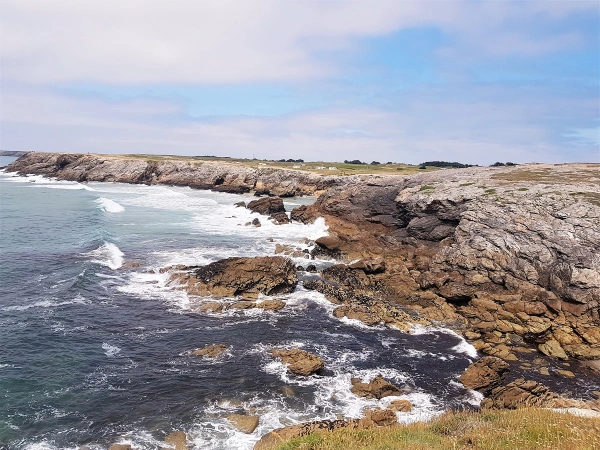
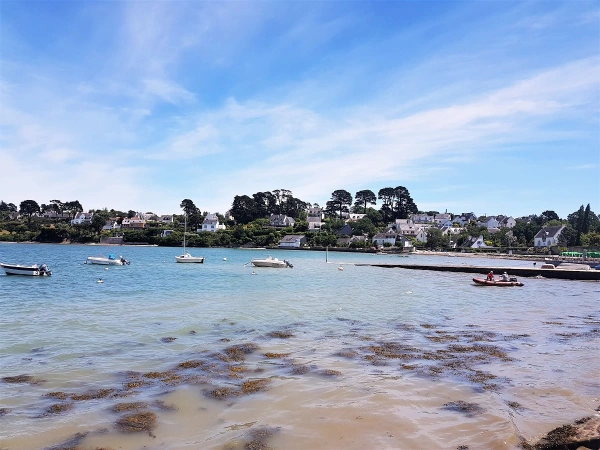
Île aux Moines is a walking and cycling island with authentic Breton village character, accessible prehistoric heritage, and sheltered coastal scenery shaped by tidal channels and estuary light. It is not a white-sand resort. It is not Belle-Île-en-Mer in terms of beach scale or infrastructure depth.
Plage du Locmiquel and Plage de Nioul are pleasant and small. The heathland and Scots pine woodland on the northern end are distinctive. The view across the gulf from the eastern coastal path on a clear morning is genuinely memorable. That is the honest inventory. Calibrate to it and the island consistently earns its crossing fee.
Ferry Access: Operator, Fares, and Schedule Realities
Izenah Croisières runs the sole scheduled ferry service to Île aux Moines. The main departure point is Port-Blanc in the commune of Baden, about 20 minutes by car from Vannes. The crossing takes five minutes. No advance booking required for foot passengers — you pay on the pontoon.
| Passenger Type | Approx. Round-Trip Fare (2026) | Notes |
|---|---|---|
| Adult | €10–12 | Pay cash or card at embarkation |
| Child (4–11 years) | €5–7 | Under 4 travel free |
| Bicycle | €4–6 extra | Per bike, charged each crossing |
| Dog | €2–3 extra | On lead required on board |
The Port-Blanc Departure Point
Port-Blanc is the practical choice for most visitors arriving by car. The car park at the embarkation point holds roughly 250 vehicles and fills quickly on summer weekends. There is an overflow zone a short walk away, but the better solution is arriving before 9am when the first wave of summer visitors is still on the road. In May, September, and October, parking is a non-issue at almost any arrival time — one of the clearest benefits of shoulder-season travel.
Frequency and Off-Season Schedule Risk
High season runs roughly June through September. During those months, ferries operate approximately every 20 minutes from the first morning crossing to late evening. Outside high season, the schedule drops to every 45–60 minutes and the last ferry moves earlier. Verify the current timetable directly with Izenah Croisières before travelling in March, April, October, or November — missing the last boat is an expensive mistake to make on a 320-hectare island with limited overnight accommodation options.
The Island in Six Numbers
320 hectares. 600 permanent residents. 20km of walking paths. Five-minute ferry crossing. 400,000-plus annual visitors. Six-plus accessible megalithic sites. Those figures define the island’s core tension: a small, historically significant place absorbing visitor volumes it was never built to handle. The only variable within your control is timing.
Three Routes That Justify the Crossing
These are not vague suggestions. Each route has a specific distance, a time estimate, and a clear verdict on who it suits best.
-
The Full Coastal Circuit — approximately 20km, 4–5 hours on foot or 2–2.5 hours cycling. This route traces the island’s full perimeter, passing Plage du Locmiquel, the heathland at Pointe du Trec’h, the narrow tidal channels near Pointe de Brouel, and the open gulf views from the northeastern headlands. The northeastern stretch — from mid-morning when light comes off the water — is the visual highlight of the entire island. Download the route on Komoot before boarding (search “Île aux Moines tour” for user-verified GPX files) or use Maps.me with the offline Brittany pack. On-island signage has gaps, and discovering those gaps at a fork in the heathland is a poor use of your time. Verdict: the definitive way to understand the island’s full geography. Cycling suits pace; walking suits those planning inland detours to the megalithic sites.
-
The Prehistoric Interior Walk — 8–10km, 2.5–3.5 hours on foot. This is the route most day visitors skip, which is the strongest argument for prioritising it. From the village centre, head inland toward the northern half of the island, hitting Dolmen de Pen Hap, the stone alignments, and the menhirs near the island’s high ground. The terrain shifts from maintained path to rough heathland. In spring it is muddy; by July it is dry and fragrant with heather. A printed map from the tourism office near the ferry landing is worth collecting for this route — GPX files available online vary considerably in accuracy for the interior section. Verdict: the most distinctive experience Île aux Moines offers that no other Morbihan island replicates in a single morning. If you skip this walk, you have largely visited an island that competes with dozens of others along the Breton coast.
-
The Village and Beach Loop — 3–4km, under 90 minutes. From the ferry landing, walk the village streets, visit the church, head directly to Plage du Locmiquel for beach time, then return via the sheltered eastern coastal path. This loop covers the two things most first-time visitors actually want — the village character and the best beach — without requiring terrain commitment or bike access. Verdict: the correct call if you are visiting with young children, have limited mobility, or are working with under three hours on the island. Do not try to force the coastal circuit into a two-hour window. The short loop done well beats the full circuit done badly.
Month-by-Month Risk Assessment: Timing the Visit
The visit experience on Île aux Moines shifts more by month than almost any other single factor. Here is the data across the full year.
| Month | Crowd Level | Weather Reliability | Facilities Open | Verdict |
|---|---|---|---|---|
| January–February | Very low | Cold, wet, windy | Minimal | For solitude only. Most cafés and rental shops closed. |
| March–April | Low | Mild, variable | Partial | Good for walkers. Spring wildflowers on the heathland. |
| May | Low–moderate | Increasingly reliable | Full | Best month overall. Long days, low crowds, full services. |
| June | Moderate | Generally good | Full | Strong choice. Weekdays especially comfortable. |
| July–August | Very high | Hot and sunny | Full | Peak infrastructure stress. Arrive before 9am or accept friction. |
| September | Moderate, falling | Often warm and clear | Full into mid-month | Second-best window. Crowds drop sharply after the first week. |
| October | Low | Variable | Partial | Quiet. Dramatic low light. Some facilities begin closing. |
| November–December | Very low | Cold, often wet | Minimal | Off-season. The island reverts to a working community. |
May and September are the optimal windows. Weather reliability is high in both, infrastructure runs at full capacity, and crowd levels sit below the threshold where they actively degrade the experience. The trade-off for visiting in July versus May is not financial — Île aux Moines charges nothing extra in peak season. The cost is entirely in friction: queues, competition for bikes, compressed beach space, and the general sense that you are sharing a quiet island with a crowd that was never supposed to be there.
Île aux Moines vs. Île d’Arz: Which Crossing Makes More Sense
For most summer visitors, Île d’Arz is the better choice. That is the direct call. Here is the reasoning.
Île d’Arz sits roughly 4km across the gulf, is similarly car-free for tourists, and receives a fraction of the visitor volume — estimated under 100,000 annually, versus Île aux Moines’ 400,000-plus. The ferry from Conleau in Vannes takes about 20 minutes with Navix. Walking and cycling routes are comparable in quality. The beaches are similar in character. And you will not be competing for bike rentals or café tables regardless of what time you arrive.
| Factor | Île aux Moines | Île d’Arz |
|---|---|---|
| Peak season crowds | Very high | Moderate |
| Megalithic sites | 6+ accessible sites | Limited |
| Beach quality | Good (small) | Comparable |
| Bike infrastructure | Strong but overwhelmed in August | Consistently manageable |
| Ferry journey time | 5 min from Port-Blanc (Izenah Croisières) | 20 min from Vannes Conleau (Navix) |
| Annual visitors (est.) | 400,000+ | Under 100,000 |
| Summer village atmosphere | Touristy | Authentic |
Île aux Moines wins on exactly one dimension: the density of Neolithic heritage. If the Dolmen de Pen Hap and the stone alignments are your primary reason for crossing the gulf — and you plan to access them properly with a map and an early start — the island earns the visit regardless of season. For everyone else arriving in July or August without that specific agenda, Île d’Arz delivers the same core experience with a fraction of the overhead.
The Gulf of Morbihan is one of the most ecologically and historically significant coastal environments in Western Europe. As annual visitor numbers across its islands continue to climb, the pressure on small-island infrastructure compounds year by year. How that pressure is distributed — concentrated in eight summer weeks or spread across a longer season — is shaped, one visit at a time, by individual timing decisions.