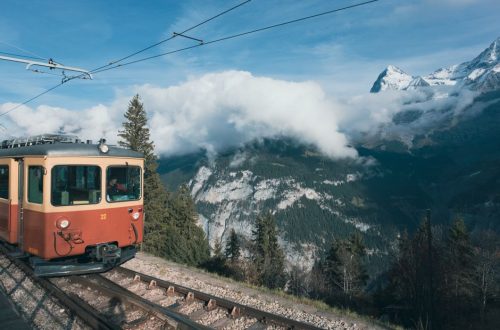
The strongest June rail plan is a three-night route with two train changes at most: Paris to Brussels to Amsterdam, Vienna to Budapest, or Rome to Florence to Bologna. These trips keep station time below airport time, leave room for long lunches, and limit the cost of a missed connection. June 2026 is also a useful month for testing a rail pass, but only when you have enough long journeys to justify it.
Which June rail hops work for a three-night break?
The right route is built around travel time, not a map. A city that looks close can still consume half a day once you add a station change, a border check, or a slow regional connection. For a short summer break, choose one anchor city, one easy second stop, and a final city with a direct airport or rail link home.
Best western route: Paris, Brussels, and Amsterdam
This is the simplest first rail hop. Paris to Brussels takes about 1 hour 22 minutes on the direct Eurostar service, while Brussels to Amsterdam takes about 1 hour 53 minutes. The three cities have central stations, dense hotel choices, and enough museums, food markets, and parks for a two-night stay. The drawback is demand: Friday afternoon and Sunday evening trains can sell out or become expensive.
Best central route: Vienna and Budapest
Vienna to Budapest has a direct ÖBB connection roughly every hour, making it more forgiving than a route that depends on one daily departure. Choose Vienna for museums and cafés, then Budapest for thermal baths, river views, and a lower daily spend. A third stop is possible, but Prague adds too much movement for only three nights.
| Route | Fastest stated rail time | Good trip length | Main risk | Verdict |
|---|---|---|---|---|
| Paris–Brussels–Amsterdam | 1h 22m plus 1h 53m | 3 nights | High weekend demand | Best first rail break |
| Vienna–Budapest | About 2h 40m | 3 nights | Summer heat | Best value pairing |
| Rome–Florence–Bologna | About 1h 30m per main hop | 4 nights | Too many day trips | Best food-focused route |
For a first June trip, the western route wins because the transfers are clear and the cities work even in heavy rain. The central route wins on value.
How do you build a June rail route without wasting a travel day?
Short breaks fail when travelers count train hours but ignore the full door-to-door cost. A 90-minute train can still require an early hotel checkout, a long walk to the station, luggage storage, and a late check-in. Use a simple planning rule: every move must buy you a different experience, not just another pin on a map.
The 90-minute transfer rule
For a same-ticket connection, 20 to 30 minutes can work at a large station. For separate tickets, allow at least 90 minutes. The extra time covers a late arrival, platform changes, a crowded concourse, and the need to find food or a working toilet before departure. On a short holiday, a missed connection can erase an entire afternoon, so the longer buffer is worth more than a slightly cheaper fare.
The two-night minimum rule
- Stay at least two nights in the first major city.
- Put the longest rail journey before the final night, not on the day of your flight.
- Use a direct route for the last leg to your departure airport or home station.
- Save one flexible afternoon for rain, strikes, heat, or a delayed train.
- Keep luggage to one carry-on-size bag if you plan to change hotels.
Do not schedule a museum reservation, concert, or airport connection within two hours of a cross-border arrival. Rail is often reliable, but a short trip has no spare day to absorb a disruption. The clear verdict is to visit fewer cities and give each move a real purpose.
What can break a short European rail break?
The biggest risk is not a dramatic rail failure. It is a chain of small errors: a nonrefundable hotel booked before a train, a station with two similarly named terminals, a suitcase too large for a crowded carriage, or a connection that leaves ten minutes after the scheduled arrival. Short trips punish optimistic planning because one error removes a large share of the holiday.
Missed connections and separate tickets
A single booking usually gives you stronger rebooking protection than two unrelated tickets. If you buy Paris–Brussels from one operator and Brussels–Amsterdam from another, the second operator may treat a late first train as your problem. Save screenshots of both tickets, learn the refund rules before departure, and keep the next viable train visible in your phone. A flexible fare can cost more at checkout and less after a disruption.
Heat, luggage, and station mistakes
- June can bring hot platforms and crowded carriages, so carry water and a light layer.
- Check the exact station name. Paris has several major stations, and Rome has more than one useful departure point.
- Keep passports, medication, chargers, and one change of clothes in a small day bag.
- Do not assume every European train has a large suitcase rack near your seat.
- Download tickets and maps before leaving hotel Wi-Fi.
When not to take the ambitious route
Do not add Switzerland, Italy, and the Netherlands to one long weekend because the map makes them look connected. You will trade local meals and sleep for station transfers. Also skip a night train when the trip is only three nights and you need reliable rest. A night train can save a hotel night, but an uncomfortable berth or a late arrival can damage the next day. The practical verdict is simple: choose the route with the fewest points of failure, not the largest country count.
Do you need travel insurance for a June rail hop?
A rail ticket does not replace travel insurance. It may cover transport to the next station, but it will not automatically pay for a nonrefundable hotel, medical treatment, baggage theft, or a missed flight caused by a delay. Insurance should protect the financial parts of the trip that rail operators do not control.
What cover matters most for a short trip?
Prioritize emergency medical cover, trip interruption, baggage limits, and delay cover. Read the trigger for delay benefits: some policies require a minimum delay, official proof from the carrier, or receipts for meals and lodging. A missed connection caused by your late arrival at the station may be excluded even when a mechanical failure would qualify.
How should you compare insurers?
Look at the underwriter, not only the brand on the quote. Allianz SE carried an A+ Superior AM Best financial strength rating with a stable outlook in March 2026, but that rating concerns financial strength and does not guarantee that a particular Allianz Travel Insurance claim will be paid. J.D. Power scores can help assess digital service or customer experience in the relevant insurance study, yet they do not replace reading a rail-delay exclusion. Get multiple quotes and compare the wording line by line.
Which exclusions can change the result?
| Coverage question | What to verify | Common trap |
|---|---|---|
| Pre-existing condition | Look for the look-back period and waiver deadline | Symptoms can count even without a formal diagnosis |
| Rail delay | Check the minimum delay and proof required | A tight self-made connection may not qualify |
| Medical treatment | Confirm limits, excess, and emergency rules | Government health cover may not pay overseas bills |
Premiums vary by state, age, trip cost, medical history, destination, and individual factors. No U.S. state generally requires travel insurance for a European rail holiday, but visa rules, residence status, and state-specific policy availability can affect what you can buy. Check your state insurance department and the policy certificate before departure. For a short, inexpensive trip, self-insuring may be rational; for prepaid hotels, medical risk, or a costly final flight, comparison shopping for cover is the safer choice.
What should you book first for a June rail hop?
Book the constrained parts first: international high-speed trains, scarce hotel rooms, and timed museum entries. Leave cafés, parks, and neighborhood walks flexible. That order protects the trip without turning every hour into a contract.
A practical 2026 booking sequence
- Choose two or three cities connected by direct trains.
- Check the operator timetable and exact station names for every leg.
- Price restricted tickets, flexible tickets, and a rail pass side by side.
- Reserve seats on high-speed and night trains before popular June dates fill.
- Book hotels with a cancellation window when the rail schedule is not final.
- Save confirmation numbers, emergency contacts, and delay rules offline.
The final verdict for a short summer break
For most travelers, Paris–Brussels–Amsterdam offers the cleanest June rail experience, while Vienna–Budapest is the stronger value route and Rome–Florence–Bologna is the best food-led alternative. Keep the itinerary to two or three cities, allow 90 minutes for separate-ticket connections, and compare a pass against real advance fares. That is how a June trip begins with one train platform and ends with enough energy left to enjoy the last evening.