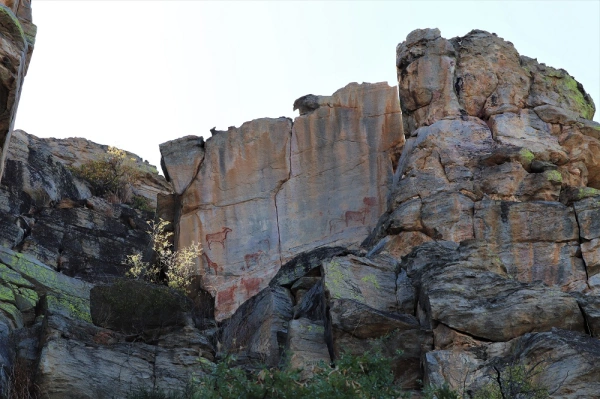
Tsodilo Hills is the best rock art destination in sub-Saharan Africa. Not one of the best. The best. Over 4,500 individual paintings across 400 sites, compressed into four quartzite hills rising out of the Kalahari sand. The San people have called it sacred for at least 100,000 years. UNESCO agreed in 2001.
Getting there is genuinely hard. That’s partly why it stays worth visiting.
Why Tsodilo Hills Rewards the Detour
Most travelers skip it. Chobe and the Okavango Delta dominate every Botswana itinerary, and Tsodilo sits 400km southwest of Maun in the far northwest, accessible only by sandy 4WD track. For package tourists, it doesn’t fit the schedule. Their loss.
What you get for the effort is access to one of the most significant archaeological sites on earth. The paintings span multiple civilizations and thousands of years — animals that no longer exist in the region, human figures mid-ceremony, geometric patterns researchers are still working to decode. Female Hill alone holds over 2,000 paintings.
The scale is hard to communicate before you’re standing there. You’re not peering at a handful of faded marks on a single wall. You’re walking through an open-air gallery that outranks any museum collection of ancient art on raw density alone. Some paintings sit at eye level. Some hide in overhangs. Some stack in panels so dense you need to stop for twenty minutes on a single wall just to absorb them.
The Four Hills: What Each One Offers
Female Hill (Nqabe) is the largest and most visited, holding the majority of paintings and the main walking trails. Male Hill (Madume) is steeper and less accessible — genuinely worth it for fit hikers, skippable for casual visitors. The Child Hill has fewer paintings but gives good geographic context for the whole landscape. The fourth, unnamed hill is completely off-limits: it’s considered sacred by the resident San community and no entry is permitted under any circumstances.
Budget your time by hill. Female Hill alone deserves at least half a day, more if you’re engaged with the paintings rather than just walking past them.
The Art Itself
The paintings are made in red ochre, with some in white and brown. You’ll see eland (the most common subject by far), rhino, giraffe, hippo — and penguins. Penguins, in the Kalahari Desert. That single painting tells you something significant about how old this tradition is and how broadly the San people traveled or exchanged knowledge across the continent.
There are also depictions of whales and deep-sea fish that don’t live anywhere near here. Researchers interpret these as evidence of long-distance trade routes or ritual knowledge exchange across southern Africa dating back thousands of years. Your guide will walk you through the interpretations — including the ones still contested in academic circles.
Getting to Tsodilo Hills: The Real Logistics
This is the section most travel pieces skim. Don’t skim it. Getting the approach wrong means getting stranded in one of the most isolated corners of southern Africa.
Tsodilo is reached from two main starting points. From Maun, you’re looking at roughly 420km one way — north on the A3 toward Sehithwa, then west through Nokaneng and Sepupa. The final 60-70km is on deep sand tracks through the bush. In a standard sedan or unmodified 2WD vehicle, you will not complete the journey. No exceptions, no workarounds.
From Shakawe in Botswana’s far northwest, it’s about 70km south — much shorter, but still requires a capable 4WD for the final stretch. Shakawe has a fuel station, basic supplies, and a handful of guesthouses. If you’re entering Botswana from Namibia via the Mohembo border crossing, Shakawe is your natural staging point and cuts the total driving significantly.
What Vehicle You Actually Need
High-clearance 4WD with low-range capability — that’s the baseline, not a suggestion. A Toyota Land Cruiser 76 Series or 200 Series is the gold standard for this terrain. A Toyota Hilux double-cab with a locking rear differential handles it. A Nissan Patrol is fine. What consistently fails out there: vehicles that look rugged but aren’t — the Toyota Fortuner, a standard RAV4, a Ford Everest on road tires. The sand is soft and deep in places, and a bog without another vehicle nearby means a very long wait for help that may not come quickly.
Before you leave: two full spare tires (not one — two), a recovery board set like Maxtrax or a budget equivalent, a shovel, and 48 hours of water per person. Phone signal is nonexistent on the approach tracks. A satellite communicator like the Garmin inReach Mini ($350) is genuinely worth having here — not paranoid, just practical. Fuel up fully in Nokaneng or Shakawe before heading in. There is no fuel at the site or anywhere close to it.
Guided Tours vs. Self-Drive
Several operators run fly-in access from Maun. Wilderness Safaris and Wild Expeditions Botswana both offer light aircraft transfers to a nearby airstrip, then ground transport directly to the site. Expect $400-600+ per person for a day trip. It costs significantly more than self-driving, but it eliminates the road entirely — the right call if you don’t have 4WD experience, the right vehicle, or enough time to dedicate two days to the journey.
For independent overlanders with the right setup, a packaged tour isn’t necessary. But hiring a local guide at the site is. That part is non-negotiable and covered in the next section.
The Rock Paintings: What You’re Actually Looking At
The San people who made these paintings weren’t decorating rock surfaces. The paintings are records of trance states, spirit journeys, and healing ceremonies. The eland appears so frequently not because it was the most common animal in the area, but because crossing into the spirit world was depicted as transforming into an eland. Once you understand that, every panel reads completely differently.
When your guide points out a figure that appears to have antelope legs and lines coming from its nose, that’s a healer in trance — nose-bleeding being a recognized physical marker of deep spiritual entry. Dotted lines connecting figures represent the spirit world and physical world occupying the same space simultaneously. This isn’t interpretation invented for tourist consumption. It’s what San elders have confirmed over decades of ethnographic research.
The Rhino Panel
The most famous single image at Tsodilo shows a rhino painted with extraordinary anatomical accuracy — correct proportions, visible skin folds, clear musculature. Researchers date it to approximately 1,300 years ago. Black rhino once ranged across this region. They don’t anymore. This painting is among the only records of their presence here.
The panel sits in a sheltered overhang on Female Hill. Your guide will take you to it. Do not attempt to find it independently — the trail is unmarked, the hill has multiple false paths, and the heat makes wandering off-route genuinely risky.
Photography Rules
You can photograph anything. No flash — UV from camera flash degrades iron oxide pigments measurably over time. You cannot touch any painting, ever. The oils in human skin accelerate surface deterioration. Rangers enforce this without negotiation. Don’t test it.
When to Go
May through October, dry season only. The sandy approach roads that are challenging in good conditions become completely impassable during Botswana’s rainy season, November through April. Tour operators won’t run trips. Self-drivers who attempt it in the wet months consistently regret it. If your Botswana itinerary falls in the rainy season, Tsodilo is off the table for that trip.
Permits, Guides, and Entry Rules You Cannot Skip
Tsodilo Hills is administered by the Department of Wildlife and National Parks (DWNP). Entry requires a permit purchased at the gate on arrival. 2026 fee structure (confirm at entry as these change periodically):
- Botswana citizens: BWP 30 per person (approx. $2.20 USD)
- SADC residents: BWP 50 per person (approx. $3.70 USD)
- International visitors: BWP 200 per person (approx. $15 USD)
- Vehicle entry: BWP 50
These fees are low. Pay them without complaint. The gate employs San community members as rangers and administrators, and the permit system is one of the few stable income sources for a community with very limited economic options in this remote area.
A guide is mandatory — you cannot walk any trail at Tsodilo unaccompanied. The DWNP assigns local guides from the resident San community; you pay the guide directly at a rate set by the site (confirm the current figure at the gate when you arrive). This is not a bureaucratic nuisance. The trails on Female Hill are genuinely confusing, the paintings are not signposted, and a good guide delivers interpretive depth that no guidebook, documentary, or academic paper replicates when you’re standing in front of the actual panels.
- No touching any painting — actively enforced by rangers on the trails.
- No drones — aerial photography is prohibited over the sacred site.
- No collecting rocks, plants, soil, or any material from the site.
- The unnamed fourth hill is completely off-limits, no exceptions.
- Keep noise down — some sections near active ceremonial areas have specific quiet requirements.
Where to Sleep Near Tsodilo Hills
Options are limited. This is remote Botswana. Plan around that reality rather than hoping infrastructure exists that doesn’t.
| Option | Type | Approx. Cost | Facilities | Best For |
|---|---|---|---|---|
| DWNP Campsite (on-site) | Campsite | BWP 100-150 per person/night (~$7-11 USD) | Basic ablutions, braai stands, no electricity | Overlanders with full camp kit |
| Tsodilo Cultural Village | Community accommodation | BWP 300-400 per person (~$22-29 USD) | Basic chalets, communal meals available on request | Budget travelers wanting a roof |
| Drotsky’s Cabins (Shakawe) | Family guesthouse | $80-120 USD per chalet | En-suite rooms, meals, fuel station nearby | Staging point before or after the visit |
| Fly-in lodge (via operator) | Safari lodge | $350-600+ USD per person | Full service, meals and transfers included | Travelers without 4WD capability |
The DWNP campsite is the clear choice for overlanders. It sits directly at the base of the hills, which means you wake up there — morning light on quartzite, complete quiet before any day visitors arrive. Book ahead through the DWNP Maun office if you can, or simply arrive early; the site is rarely full except during peak Botswana school holiday periods in July and August.
Drotsky’s Cabins near Shakawe is the best comfort option if you want a solid bed the night before. Family-run for decades, positioned on the Okavango Panhandle, and serves reliable food. It’s a good place to debrief after the site too.
Mistakes That Wreck a Tsodilo Visit
Treating it as a day trip from Maun. The round journey is over 800km of hard driving. Arriving exhausted after four hours on sand tracks, rushing through two hours of walking, and driving back the same evening wastes the entire journey. Stay at minimum one night at the campsite.
Not checking road conditions before you leave. The tracks from Nokaneng deteriorate rapidly after any rainfall, even outside the official rainy season. Ask fuel station attendants and roadside traders in Nokaneng before committing to the final stretch — they know the current state of the sand better than any app or tourism website.
Under-estimating Female Hill’s physical demands. The full circuit covers roughly 10km with real elevation change. In Kalahari heat — 30°C or above from September onward — that takes 4-5 hours minimum at a pace that actually allows you to look at the paintings. Bring at least 3 liters of water per person. Nothing is sold on the trails.
Relying on Google Maps for navigation. It has the main access road, partially. Once you’re on the final approach tracks, it becomes useless and occasionally points in the wrong direction. Download offline maps through Maps.me or OsmAnd before leaving Maun, and save the campsite GPS coordinates before you lose signal: approximately S18°44′, E21°44′.
Being impatient with the guide. The San guides at Tsodilo carry knowledge about their own cultural heritage that no outside expert, travel writer, or academic paper replicates when you’re standing in front of the actual panels. Visitors who rush the guide or half-listen to the explanations miss the entire point of making the journey. Slow down and ask questions.