Most travelers land in Hanoi, order a bowl of pho on day one, and think they’ve covered Vietnamese food. They haven’t. Pho is one dish from one region in a country with 54 ethnic groups and over 3,000 kilometers of coastline. The food changes every few hundred kilometers — different ingredients, different flavor logic, completely different techniques. This guide covers what to actually eat, where to find the best versions, and how to avoid the watered-down, tourist-priced imitations that dominate most itineraries.
Vietnamese Food Is Not What You Think
Vietnam’s food divides into three regions that cook so differently they barely resemble each other: restrained and savory in the north, spicy and historically complex in the center, sweeter and herb-heavy in the south. Pho is the entry point. Everything after it is the actual trip.
The Regional Food Map Every Visitor Should Know
Before ordering anything, know where you are on the flavor map. A bowl of Hanoi pho and a bowl of Hue’s bun bo hue are not variations on the same dish — they reflect completely different cooking philosophies. Here’s how the three regions compare:
| Region | Flavor Profile | Signature Dishes | Key City | Avg Street Meal Price |
|---|---|---|---|---|
| North | Savory, restrained, minimal sweetness | Pho Bo, Bun Cha, Cha Ca La Vong | Hanoi | 40,000–70,000 VND (~$1.60–$2.80) |
| Central | Spicy, layered, complex | Bun Bo Hue, Cao Lau, Banh Mi, Mi Quang, Banh Xeo | Hue / Hoi An | 35,000–60,000 VND (~$1.40–$2.40) |
| South | Sweet, fresh, herb-forward | Com Tam, Hu Tieu, Goi Cuon, Banh Xeo | Ho Chi Minh City | 50,000–90,000 VND (~$2–$3.60) |
Why Most Tourists Skip the Best Region
Central Vietnam — specifically Hue and Hoi An — gets far less food attention than Hanoi or Ho Chi Minh City, mostly because it sits between them on the itinerary and gets squeezed out. That’s a real loss. Hue was Vietnam’s imperial capital for 143 years, and the food reflects that legacy. Bun Bo Hue costs around 40,000 VND at a local stall and delivers more complexity than most dishes twice its price in a tourist restaurant. The fermented shrimp paste and lemongrass base has no equivalent anywhere else in the country.
Northern Pho Is Not the Pho You’ve Had at Home
Most Vietnamese restaurants outside Vietnam serve the southern Saigon style — wider noodles, a sweeter broth, bean sprouts on the side, fresh herbs piled separately. Hanoi pho is different. Thinner noodles, a cleaner and more deeply savory broth, thin slices of beef only, no bean sprouts. Ordering it for the first time in Hanoi expecting the overseas version will genuinely surprise you. The baseline to judge everything else against: Pho Gia Truyen at 49 Bat Dan Street in Hanoi’s Old Quarter, operating since 1955, selling out every morning before 9am.
10 Dishes to Eat Before You Leave Vietnam
Not honorable mentions. Each of these is a reason to book a flight.
The Dishes That Define Hanoi
- Pho Bo — The Hanoi version uses thinner noodles, a clearer and more savory broth, and no bean sprouts. The benchmark is Pho Gia Truyen (49 Bat Dan). Lines form at 6am. Cost: 50,000–65,000 VND (~$2–$2.60).
- Bun Cha — Charcoal-grilled pork patties and pork belly served in a sweet-savory dipping broth with vermicelli noodles and fresh herbs. Bun Cha Huong Lien on Le Van Huu Street became globally known after Anthony Bourdain and Barack Obama ate there in 2016. The full meal including a Hanoi bia hoi runs about 85,000 VND (~$3.40). Still on the menu.
- Cha Ca La Vong — Turmeric-marinated catfish grilled at your table and finished with fresh dill, roasted peanuts, and rice noodles. The original restaurant at 14 Cha Ca Street in Hanoi’s Old Quarter has served this single dish since 1871. Imitators now surround it on every side — only the original at this specific address follows the full traditional preparation.
Tip: Eat where the plastic stools are. Street-level setups with no signage, no English menu, and seating six inches off the ground are usually the most reliably good — food is made fresh, turns over fast, and prices are set for the people who actually live there.
Central Vietnam’s Most Distinctive Bites
- Bun Bo Hue — Wide rice noodles in a spicy, lemongrass-heavy beef broth with pork knuckle and optional congealed blood cake. Richer and more complex than pho. Best eaten in Hue itself, where nearly every stall runs its own slight variation on the base. Price: 40,000–55,000 VND (~$1.60–$2.20).
- Cao Lau — Thick, chewy wheat noodles with sliced pork, crispy rice crackers, and herbs in a small amount of broth. The noodles require water drawn from a specific well within Hoi An’s old town — which is why authentic Cao Lau doesn’t exist outside the city. Any morning market stall will have it. Price: 50,000–70,000 VND (~$2–$2.80).
- Banh Mi — A Vietnamese baguette layered with pâté, char siu pork, pickled daikon, cucumber, and fresh cilantro. Banh Mi Phuong on Phan Chau Trinh Street in Hoi An has been operating for over 20 years. Anthony Bourdain called it the best sandwich he’d ever eaten. Price: 30,000–40,000 VND (~$1.20–$1.60). Arrive before 9am to miss the tourist queue.
- Mi Quang — Wide, turmeric-yellow noodles with pork, shrimp, hard-boiled egg, and roasted peanuts in barely enough broth to coat them. This is not a soup. Denser, more textural, and almost completely ignored by tourists. Price: 40,000–55,000 VND (~$1.60–$2.20) in Da Nang or Quang Nam Province.
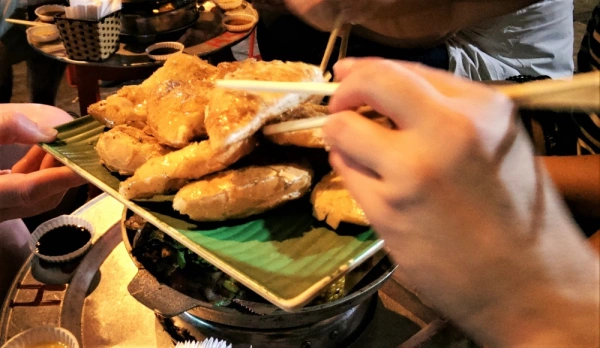
- Banh Xeo — A large, sizzling crepe made from rice flour and turmeric, stuffed with shrimp, pork, and bean sprouts. You tear off pieces, wrap them in lettuce and mustard greens, dip in nuoc cham. The name literally means sizzling cake. Best versions in Hue and Da Nang. Price: 45,000–60,000 VND (~$1.80–$2.40).
Tip: A stall that sells out by 10am is almost always the best one on the street. High turnover is the local signal for quality. If a vendor still has a full pot at noon, keep walking.
Southern Vietnam Essentials
- Com Tam — Broken rice (the cracked grains from the milling process) served with a grilled pork chop, fried egg, shredded pork skin, and a small bowl of fish sauce broth. The default lunch for millions of Ho Chi Minh City residents. The pork chop should have visible char marks and a slightly sweet marinade. Price: 50,000–80,000 VND (~$2–$3.20) at any sidewalk stall.
- Goi Cuon — Fresh spring rolls with shrimp, pork, vermicelli, and herbs wrapped in translucent rice paper, served cold with hoisin-peanut dipping sauce. Unlike fried nem, these are assembled to order and eaten immediately. Quan An Ngon (138 Nam Ky Khoi Nghia, Ho Chi Minh City) serves a reliable version in a setting accessible to first-time visitors.
How to Find the Good Stuff (Not the Tourist Version)
This is where most visitors go wrong. They follow review apps into air-conditioned restaurants with English menus and laminated photo walls, pay $10 for a bowl of pho that should cost $2.50, and leave wondering what the fuss was about. The fuss is real. They just ate at the wrong places.
Look for Specialization, Not Variety
The best street food stalls in Vietnam serve one dish. Sometimes two. A stall that sells pho, bun bo hue, banh mi, AND com tam is set up for tourists. No cook can specialize in four completely different dishes simultaneously. A stall that has been making the same bowl of bun cha since 1985 at the same corner is doing something categorically different.
Walk down a block and notice which dish every third stall is preparing. That’s the local specialty. The vendor who has outlasted every competitor around them over the past two decades is usually the best at that dish.
Eat When Locals Eat
Vietnamese street food runs on local meal schedules, not tourist hours. Breakfast stalls open between 6am and 7am and sell out by 9am. Lunch service runs from roughly 11am to 1:30pm. Some of the best vendors — particularly bun cha and bun bo hue specialists — don’t open for dinner at all. A fully stocked stall at 2pm is either new or unpopular. The area around Dong Xuan Market in Hanoi and the streets surrounding Ben Thanh Market in Ho Chi Minh City have the densest concentrations of vendors operating on actual local time.
Search Google Maps in Vietnamese
TripAdvisor surfaces businesses that actively manage their listings, which skews heavily toward tourist-facing restaurants. Google Maps reviews in Vietnamese — searched by dish name plus neighborhood — give a more accurate picture of what locals actually eat. Look for places with 500+ reviews and photos showing plastic stools and street-level cooking rather than dining room interiors. One quick price filter: if a street stall bowl of pho costs more than 80,000 VND ($3.20), it’s priced for foreigners. Not necessarily bad food, but adjust expectations accordingly.
What First-Time Visitors Get Wrong About Vietnamese Food
Is street food in Vietnam actually safe to eat?
Yes, with basic awareness. Most street food is cooked at high heat directly in front of you — which is safer than buffet trays sitting at room temperature for hours. Higher-risk items are raw vegetables, ice from unknown sources, and shellfish at outdoor markets in hot weather. A steaming bowl of pho carries far less risk than goi cuon with raw herbs. Most travelers with a normal immune system eat street food daily in Vietnam without issues. Use your eyes: high foot traffic, fast turnover, visible fresh ingredients, cook working steadily.
Do I need Vietnamese to order food?
No. Point-and-order works at almost every street stall. Look at what the person next to you is eating and point. “Mot” (one) while gesturing covers most situations. Google Translate’s camera mode reads Vietnamese menus in real time and is accurate enough for food ordering. If you have allergies, write down “khong ca” (no fish) or “khong thit” (no meat) before leaving your accommodation — showing the written phrase is faster and clearer than trying to pronounce it cold.
Will I get stuck at restaurants I can’t read?
Single-item stalls often have no menu at all — you sit down and they bring you what they make. That’s not a problem, it’s the model. Multi-item local restaurants with Vietnamese-only menus are navigable with a translation app or by pointing at other tables. The anxiety of the unreadable menu disappears after the first day. By day three, most travelers walk confidently into stalls with no signage and no English anywhere in sight.
Hoi An Is the Best Food City in Vietnam
Not a qualified opinion. Not one of the best. Hoi An wins outright.
Why Hoi An Beats Hanoi and Ho Chi Minh City for Food
Hanoi has the depth. Ho Chi Minh City has the scale. But Hoi An concentrates more genuinely excellent, affordable, and regionally specific food into a walkable area than any other city in Vietnam. Central Vietnamese cooking is technically among the most complex in the country — layered seasoning, multiple components, dishes shaped by centuries of imperial court tradition. And you can eat it for under $3 a meal at stalls that have occupied the same spots for decades.
Banh Mi Phuong is here. The morning market on Tran Phu Street has vendors who’ve held the same corner for 30 years. Mi Quang, Banh Xeo specialists, and Cao Lau stalls all sit within walking distance of the old town. For pho specifically, Hanoi does it better. For com tam, Ho Chi Minh City wins. But if you want to understand what makes Vietnamese food structurally distinctive — the freshness logic, the herb philosophy, the fierce regional precision — Hoi An makes that case more completely than anywhere else.
The Dishes That Only Exist Here
Cao Lau noodles are made with ash water drawn from the Ba Le Well, a specific source within Hoi An’s old town. That process produces a texture and slight bitterness that cannot be replicated with water from any other location. Restaurants in Hanoi that put Cao Lau on the menu produce a noticeably different dish. White Rose dumplings (Banh Bao Vac) go further — a single family in Hoi An makes all the wrappers, distributing only to select restaurants in the old town. These two dishes alone justify the detour to central Vietnam.
Back to where we started: pho is the entry point. It’s a perfectly good place to begin. But after eating Cao Lau before 9am at a market stall, a bowl of Bun Bo Hue that smells of lemongrass from across the room, and a Banh Mi from Phuong with the bread still warm — pho starts to feel like the first chapter of a much longer book. That’s exactly the right feeling. It means you’ve finally started reading.